
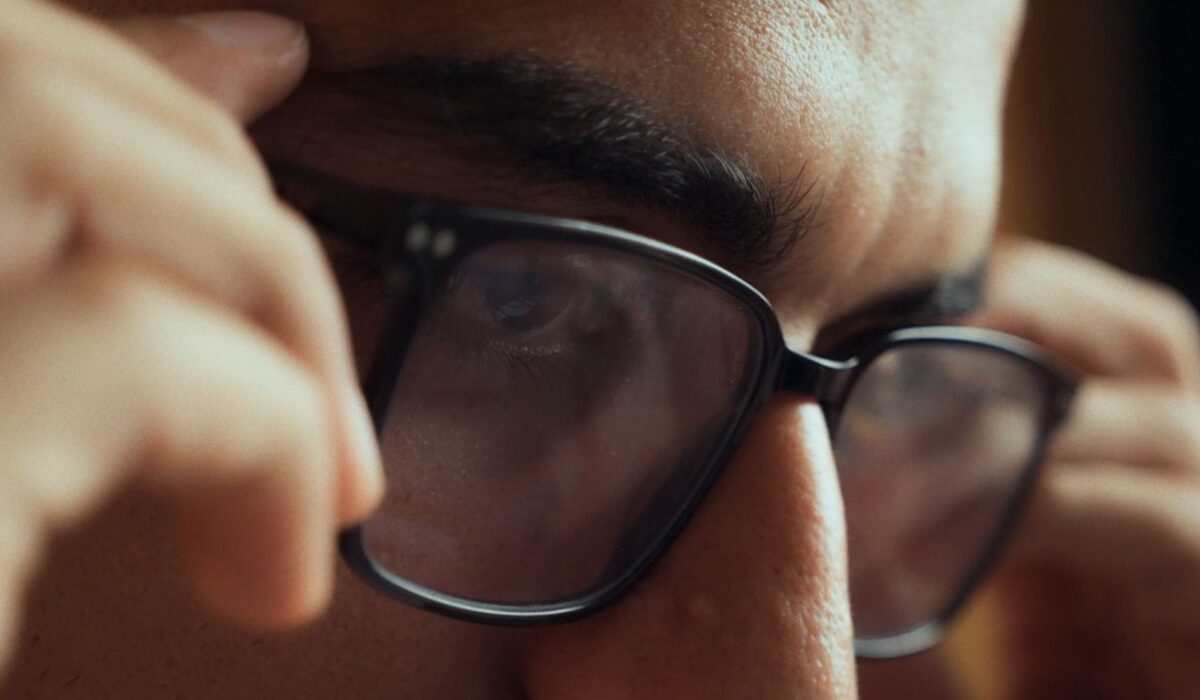
In the now-famous scene from the 1996 film, Mission: Impossible, Tom Cruise, playing super-spy Ethan Hunt, drops from inside the ceiling of a heavily guarded room at CIA headquarters. The suspense builds as the mission goes sideways and, hanging from a rope just centimetres from a floor filled with sensors, a droplet of sweat begins to roll down his glasses.
These may be the most famous ‘smart glasses’ in cinematic history, sending live video footage back to Hunt’s comrades. At the time they were unmistakably futuristic; 30 years later they’re actual reality.
‘Smart’ sunnies and specs made by household names like ‘Ray-Ban’ and ‘Oakley’ now allow you to take high-resolution photos, record high-definition video, speak with an AI assistant, and more.
For some, this new tech may sound quite exciting. And the glasses have genuinely useful applications: people with accessibility needs can, for instance, use certain smart glasses to have live captions of conversations presented directly to them as they make phone calls.
But there are significant risks associated with the technology, especially when it comes to the workplace. Many models available today are almost indistinguishable from a normal pair of reading glasses or sunglasses, meaning they can record people without those around them realising it is happening – which raises serious concerns around privacy and consent.
At work, an employee could record a conversation with a colleague or capture information on a computer screen without making it obvious that they are doing so. This is particularly relevant to NFPs, where employees and volunteers may work closely with vulnerable people and handle sensitive information.
The issue is attracting attention at the highest levels – so much so that the Albanese government is considering banning smart glasses in public offices and buildings.
To unpack the key risks and legal implications of employees wearing smart glasses in NFP workplaces, we spoke with Professor Carol Kulik, a Bradley Distinguished Professor at the Adelaide University’s Centre for Workplace Excellence and an expert in human resource management, and Dr Adriana Orifici, Senior Lecturer and Director of the Labour, Equality and Human Rights (LEAH) Group in the Department of Business Law and Taxation at Monash University.
What are the main risks of smart glasses use in NFP workplaces?
For NFPs, smart glasses pose risks around client confidentiality, safeguarding and workplace trust. Because the devices can record discreetly, people may not realise they’re being filmed. Professor Kulik warns that this can undermine “human-to-human interactions”, leaving clients or colleagues feeling exposed or deceived if they discover they’ve been recorded without their knowledge.
“That effect strikes me as particularly problematic in an NFP context, where so much of the work is relationship-based,” she says. “NFP service providers have to work very hard to build trust with vulnerable clients, and tools like these [can] put that trust at risk.”
There are also risks around what the glasses capture. Employees may inadvertently record clients sharing sensitive information or capture confidential details in the background. If these recordings are shared or exposed, the consequences could extend beyond the people directly involved. A breach could compromise a client’s privacy and cause reputational damage to an entire organisation.
Employees could also use the devices to record colleagues, managers or workplace disputes without their knowledge, threatening psychological safety by making people feel watched and less comfortable speaking up.
Finally, using smart glasses to record people at work could also breach privacy or surveillance laws, depending on the circumstances. For NFP leaders, understanding where the legal boundaries lie is an important part of managing the risks of this new technology.
What does the law say about smart glasses?
In short, it’s complicated. Dr Orifici says the differences between state and territory surveillance device laws are “nuanced but are potentially relevant to the use of smart glasses by a person to make a covert record of a conversation or activity”. Some states, such as NSW, also have specific workplace surveillance laws that apply to employers. She explains:
“Surveillance devices laws that apply in Victoria, NSW, WA, SA and the NT include prohibitions on the use of listening and optical surveillance devices by any person to intentionally observe or record a private conversation or activity by other people without each of those people giving express or implied consent. Under these laws, a private conversation is generally defined as one carried out in circumstances where the person or people involved may reasonably be taken as desiring that it only be listened to by themselves, or by some other person who has their express or implied consent to listen.”
The legality of recording with smart glasses may depend on where the workplace is, what is being recorded, whether the conversation or activity is private, and whether consent has been given.
According to Dr Orifici, “private activity” is defined differently across the jurisdictions, but generally includes “an activity undertaken by one or more people in circumstances that may reasonably be taken to indicate that they desire it to be observed only by themselves”.
To complicate matters further, the definitions of “private activity” under state and territory surveillance laws differ. For example, in Victoria, a private activity doesn’t generally include an activity that takes place outside a building. In South Australia, a private activity generally doesn’t include an activity carried out in a public space.
In the ACT, Tasmania and Queensland, “legislation prohibits a person from using a listening device to make audio recordings of other persons’ private conversations without their consent”. Under the laws of these three jurisdictions, the definition of “listening device” is likely to include smart glasses. Importantly, however, they “do not cover optical recordings of private activities in the same manner as surveillance devices laws in other states and territories”.
Dr Orifici says it’s also worth considering that “surveillance devices laws are framed around the presence, or absence, of consent by the parties whose conversation or activity is being recorded. In the context of the workplace, circumstances when a person might reasonably view their conversations or activities as private could be unclear.”
Here’s how to address the risks in your NFP:
1. Set clear boundaries around when and where smart glasses can or cannot be used
To develop a policy to cover employee use of smart glasses, organisations need to consider where smart glasses can be used, where they should be restricted and where they should be prohibited altogether. These decisions should reflect the nature of the work and the potential consequences of recording in different situations.
For NFPs supporting vulnerable clients or handling confidential information, for example, Professor Kulik encourages setting strong boundaries around recording during client interactions and discussions of employee performance. “These are situations where people reasonably expect a high degree of privacy, and violating those expectations can have serious consequences for organisational relationships,” she says.
There may also be circumstances in which an employee or employer sees smart glasses as a useful tool at work. A manager might want to record a difficult conversation, for example, while an employee might see recording as a way to document bullying or harassment. In these cases, organisations need to be clear about when recording is acceptable and what people must be told before it happens.
It is also imperative in these cases to set boundaries around what happens to recordings once they’ve been made. Organisations should specify whether footage can be uploaded to apps or cloud services, shared with third parties or processed by AI tools, particularly where it contains sensitive client or workplace information.
2. Develop a policy that works across your organisation
Once boundaries have been decided, organisations need to formalise them in a policy that gives employees clear, practical guidance on acceptable use.
Professor Kulik says a policy addressing smart glasses use needs to convey two key pieces of information: clear definitions of the behaviour covered by the policy and clear descriptions of the consequences of violating it.
“The policy should specify when AI use is acceptable (i.e. never, with explicit disclosure or only when confidentiality is a concern) and/or encouraged (i.e. whenever possible or only occasionally),” she says.
She also says policies should help employees understand when the technology is appropriate for their role and when recording is not acceptable. “A fundraising team, for example, will have different requirements from disability-service providers or HR staff when it comes to using smart glasses at work,” she says.
Leaders could work with team managers to identify which tasks involve sensitive information or vulnerable clients that would mean recording is unacceptable, then set clear rules around which places or times smart glasses might be okay to be used.
Without that more specific detail, she says, an employer’s policy will inevitably become too broad or too constraining. “[Blanket] policies are not effective unless employees understand how the policy applies directly to their roles. This is a place where it is more effective for policies to be built up from the units rather than to cascade down.”
Professor Kulik adds policies should specify which disciplinary measures may apply to different types of breaches. “Consequences might include verbal or written warnings through to suspension or termination.”
For example, an employee who inadvertently wears smart glasses into a restricted meeting might receive a verbal warning, while an employee who deliberately records a confidential client conversation in breach of the policy could face formal disciplinary action.
3. Make transparency a non-negotiable workplace principle
Professor Kulik says the biggest concern with smart glasses in the workplace is the uncertainty they create around what is being captured and how the technology is being used. “It’s the ambiguity that makes smart glasses problematic,” she says. “And the best way to resolve the ambiguity is through transparency.”
In practice, that means requiring all employees to be upfront. If someone is wearing smart glasses, other people must know when they’re switched on, whether they’re recording and what’s being captured. If recording is taking place, people should be told and asked for consent where required. Leaders can set the tone by being open about use of the technology, and holding conversations about it. As smart glasses become more widely used, it will be more difficult to ignore or ban them altogether. The aim is to make transparency around any sort of recording a normal part of how people work together.
–
Smart glasses have gone from science fiction to clumsy fad to mainstream technology in a remarkably short period of time. And while workplaces aren’t likely to be awash with people wearing them, it’s wise to have expectations and policies in place before problems occur.
For NFP leaders and HR teams, the challenge is working out how to manage the technology without compromising the people and relationships at the heart of the work. Being clear about when and how smart glasses are being used, and creating space for open conversations can help protect the trust on which NFPs depend.
–
Not-For-Profit People is an initiative of EthicalJobs.com.au — Australia’s top job-search site for the not-for-profit sector and beyond. More than 10,000 Australian charities, not-for-profits and social enterprises use EthicalJobs.com.au to find dedicated and passionate staff and volunteers to help them work for a better world. Find out more at EthicalJobs.com.au/advertise
Related Posts
- Every Australian employer has new duties under the Sex Discrimination Act – here’s what you need to know
- How to respond to serious incidents in the workplace – best practice guidelines from the federal parliamentary review
- Should your NFP have an employee code of conduct?
- Inquiry into workplace sexual harrassment launched by the Human Rights Commission