
Leadership

Leaders: invest in your people

– Sponsored Content – Many of us working in the not-for-profit sector have become used to accepting and at times promoting, ‘join us for meaningful work’ (not the salary), as an acceptable pitch to new talent. Yet it seems somewhat ironic that while we have one of the toughest and most important jobs in society, […]

Read more

How do successful not-for-profits develop future leaders? Part 2: What will your future needs be?

  Great leadership is central to all successful not-for-profit organisations.  In this five-part series, we look at strategies to recognise and realise the leadership potential within a not-for-profit. You can find part 1 here. Part 2 looks at how to understand what your future needs will be: Last week we got the leadership ball rolling […]

Read more

The ways women win at work: 5 minutes with Dr Lois Frankel

Dr Lois Frankel has become practically synonymous in the US with helping women succeed in work and life. Her book, Nice Girls Don’t Get the Corner Office, was a New York Times mega-bestseller that has been translated into twenty-five languages and sold a million copies worldwide. As president of Corporate Coaching International, Dr Frankel helps […]

Read more

The secret to retaining your employees? Focus on career advancement

The secret to retaining you employees? Focus on career advancement

Leaders overlook internal promotions at their peril. In a Pew Research survey, 63% of respondents who left jobs in 2021 cited a lack of advancement opportunities as a reason. And a 2022 study by consulting company McKinsey noted that a lack of career development and advancement was the most common reason given for quitting a job. With that in mind, here are three ways NFPs can use career development to retain employees for longer.

Read more

Five valuable things we learned at the 2018 Not-For-Profit People Conference

The Not-For-Profit People Conference is done for another year. And what a couple of days it was! The atmosphere was electric; the speakers inspiring; and the delegates’ enthusiasm was contagious.

It’s difficult to hand-pick the key takeaways from the conference – there were so many with 36 speakers and 23 sessions – so here are our top five based on the top issues facing people managers in NFPs today.

Read more

The 10 design principles that could make you a better leader

design thinking and design leadership

The growing popularity of “design thinking” shows just how much leaders at all levels can learn from designers.

A “design mindset” can give a leader a clear thinking or problem-solving process that works well with everyone from family members to a community, or whole organisation.

Leaders with a design mindset “paint” the way forward with colourful, wide brushes to ensure a diverse range of perspectives.

The trick is knowing which aspect of our thinking processes to listen to at which time. Is it time to converge on an idea or action? Or is it time to diverge to create more options?

Read more

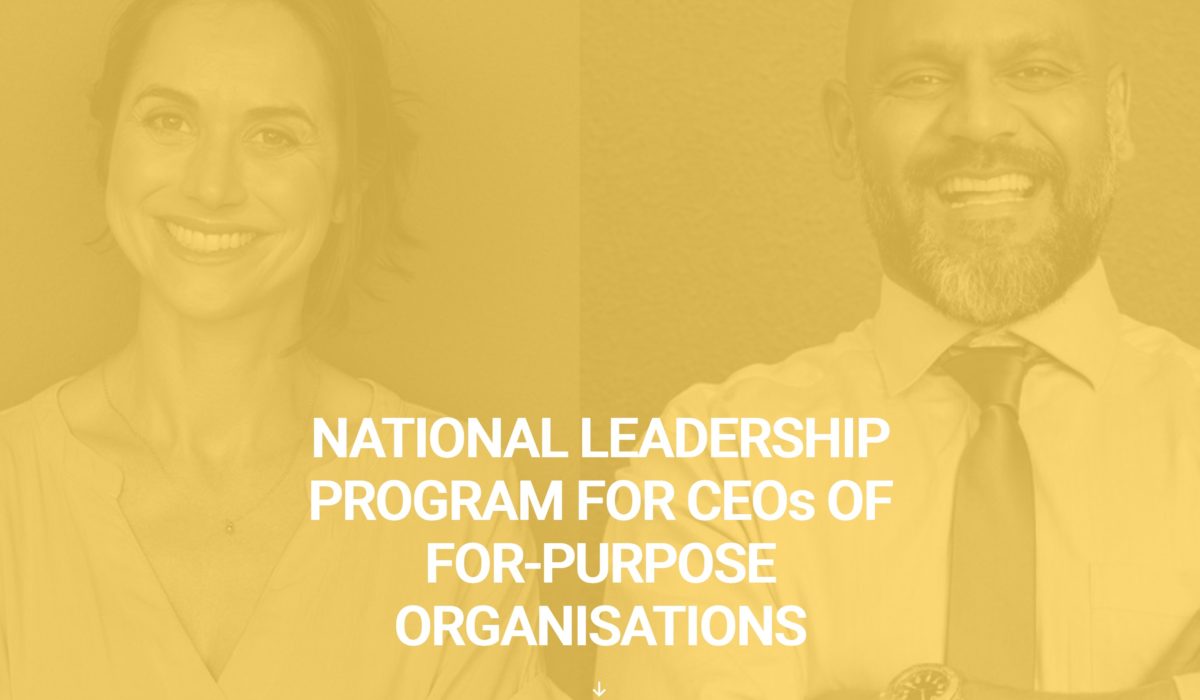
A once-in-a-lifetime leadership opportunity for NFP CEOs

Good leadership is crucial for NFPs to succeed.

That’s why four major Australian foundations have announced a collaboration to create a 10-month, national capacity-building and leadership program for CEOs in Australian not-for-profit (NFP) organisations.

The Social Impact Leadership Australia program (SILA) is an evidence-based program specifically developed to meet the needs of Australian CEOs and build the capacity of their organisations directly and indirectly.

Read more

How to make tough decisions

How to make tough decisions

Making a tough decision about your team or your organisation’s workforce can be, well…tough.

NFP leaders and managers are called upon to make tough decisions as a matter of course. But what do you do when the decision is really important, and it’s really not clear what course of action you should take?

Harvard Business School professor Joseph L. Badaracco is an expert in making what he calls “grey area” problems – ones that can sometimes be difficult to clearly assess. He suggests five practical questions you should ask yourself that can help you and your team illuminate the “greyest of grey areas”.

Read more